How We Work
Every job starts on the ground, not on paper. We walk the property, look at how water moves across it, and test the soil where the slab will sit. Baxter soil is the dominant type in Warren County and it drains well, but it changes from one lot to the next, so we never assume. The county is hilly too, with 224 feet of relief within a few miles, and a driveway on a slope needs different base work than a patio on flat ground.
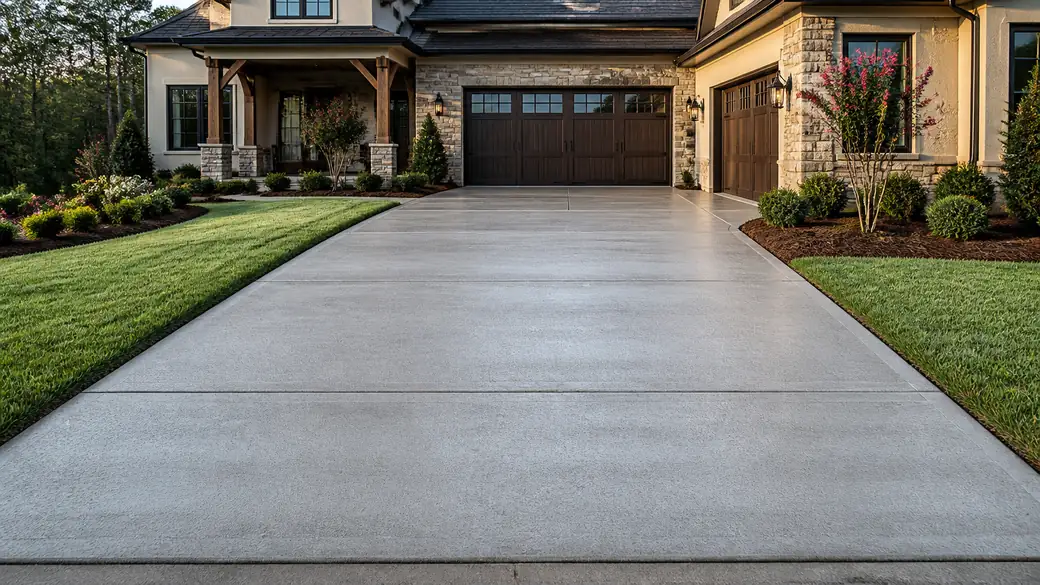
Once the grade is set, we build the forms, compact the base and place the reinforcement the slab calls for. Rebar or wire depends on the load: a driveway carrying trucks is not a walkway. We pour when conditions allow, then finish the surface to suit the project, whether that is a plain broom finish or a stamped, decorative patio. We handle the permit where one is needed. Then the concrete cures, and we tell you when it is ready for foot traffic and when it is ready for a car.
Most concrete that fails was set up to fail before the pour. A thin base, too little reinforcement or water with nowhere to go shows up later as cracks, sunken sections and puddles against the foundation. The median home in Warren County was built in 1991, so a lot of the slabs we tear out have simply done their time. Getting the replacement right costs more hours and more material below the surface, where nobody looks. That is the part we do not cut. Call for a free estimate.
Proudly Based in Bowling Green
Bowling Green is home, and Warren County is where we pour. It is a county of 75,388 people, and the typical house here was built around 1991 and is valued near $232,100. That tells us a lot about the work. Most of the driveways, patios and walkways we see went in with the house, so many of our residential projects start with breaking out an original slab and replacing it properly. We take on new construction and commercial surfaces too. Still, most of our days go to homes people already live in and plan to keep.
The ground here asks for attention. Warren County is hilly, with 224 feet of local relief within a few miles, and well-drained Baxter soil is the dominant type. Neither holds true on every lot. So we grade and test each site on its own before any forms go up. A sloped driveway in Franklin gets the same scrutiny as a flat patio in town. Reinforcement, base depth and drainage follow what the site shows us, not a standard sheet. Stamped and decorative work sits on the same groundwork, because a good surface only lasts on a good base.