+1 270-208-9064
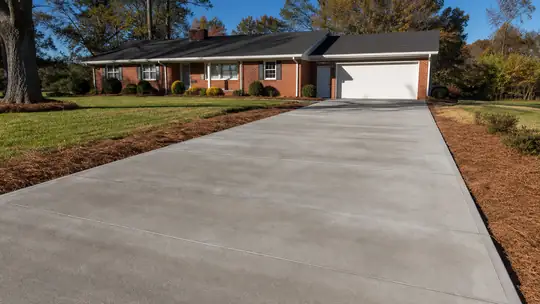
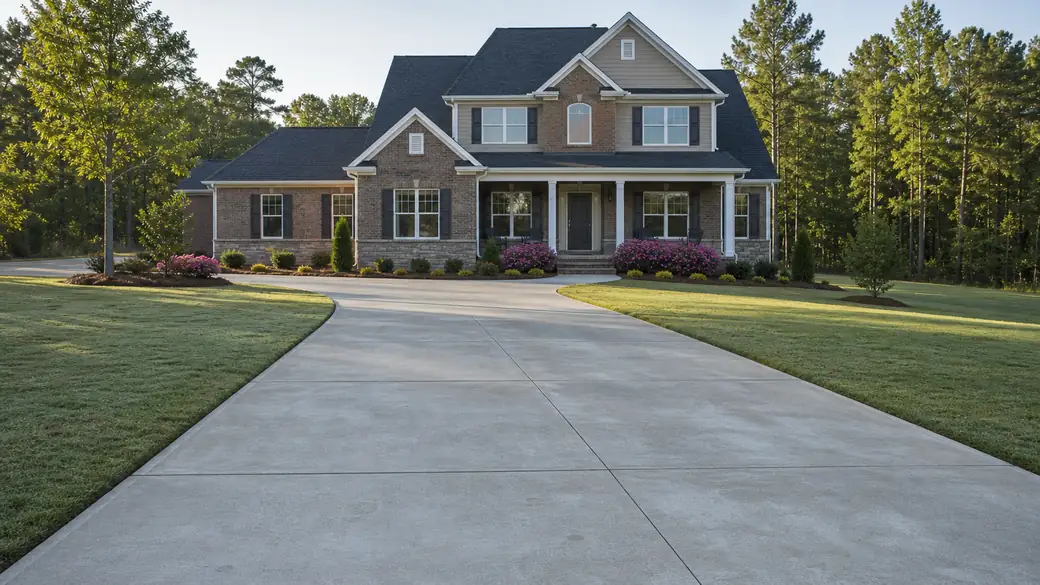
general concrete construction completed by a local contractor at a tan-brick colonial in Bowling Green, KY, in clear late-morning sun.

General Concrete Construction in Bowling Green, KY

We pour and finish concrete for homes and businesses in Bowling Green: driveways, patios, walks, garage and shop slabs, footings, and the structural work that sits underneath them. Most of our projects are residential, though we take on commercial work too. The median house here was built in 1991, so a lot of the original driveways and patios have been down a long time and are starting to show it. Some need a repair. Plenty need to come out and be poured again with proper reinforcement, and we tell you plainly which one yours is.

The ground decides whether a slab lasts. The land around Bowling Green is hilly, with 224 feet of local relief within a few miles, and it changes from one block to the next. Baxter soil is the dominant type and it drains well, but it is not what you find on every lot. So we grade and test every site on its own before a single form goes down. That work tells us how much base to bring in, where the water needs to run, and what the slab needs under it to stay flat.

Most of the cracked and sunken concrete we tear out failed for ordinary reasons. The base was too thin. There was no rebar or mesh. Water ran under an edge for years, or the pour was rushed to beat the weather. None of that is hard to prevent while the job is open. It is a lot harder to fix later, because the old slab has to be broken out and hauled off before anything new goes in. We would rather spend the extra time on prep and do it once. Call for a free estimate.

Call +1 270-208-9064

Get a Free Estimate

What Is Included in General Concrete Construction

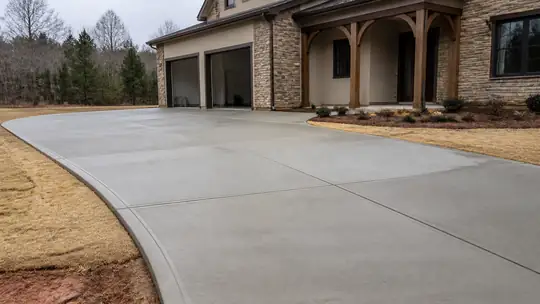
concrete slab installation completed by a local contractor at a buff-brick ranch home in Bowling Green, KY, after a rain shower.

Concrete Slab Installation Cost

The estimate for a slab covers the whole job, not just the pour: digging out, a compacted gravel base, forms, rebar or wire mesh, the concrete itself, finishing, saw-cut control joints and curing. Warren County ground is hilly and changes block to block, so grading and testing your site comes first.
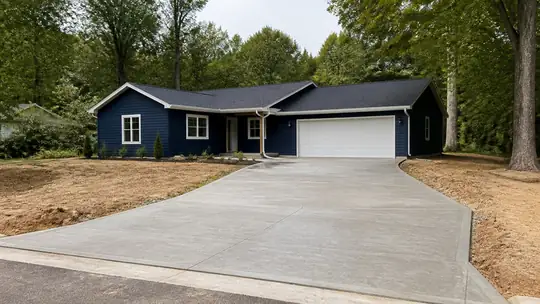
concrete driveway installation completed by a local contractor at a tan-brick colonial in Bowling Green, KY, in clear late-morning sun.

Concrete Driveway Installation

Driveways carry more weight than patios, so we build them heavier: a deeper base, rebar on chairs so it sits mid-slab instead of on the dirt, and thickened edges where tires roll off. Most cracked driveways we see were poured over soft fill. We dig that out, compact, then pour with a broom finish.

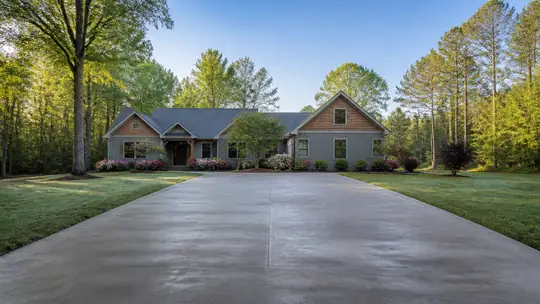
concrete flooring installation completed by a local contractor at a grey split-level home in Bowling Green, KY, at blue hour.

Concrete Flooring Installation

Interior floors for garages, shops, basements and additions start with a vapor barrier under the slab, because moisture coming up through bare concrete ruins flooring laid on top. We trowel smooth for tile or sealed finishes, cut control joints before the slab cracks on its own, and keep it damp while it cures.

concrete slab repair completed by a local contractor at a painted-white-brick two-story home in Bowling Green, KY, in late afternoon light.

Concrete Slab Repair

Not every cracked slab needs tearing out. Hairline shrinkage cracks get routed and sealed, and a sunken section can often be lifted back to level. When the base underneath has washed out or the steel has rusted through, a patch only hides the problem, and we say so before quoting a repair.

Our Warranty and Guarantee

What we stand behind is the part you stop seeing once the pour is done: the base, the reinforcement and the joints. Warren County is hilly, with 224 feet of local relief within a few miles, so every site is graded and tested on its own before we set a single form. Baxter soil, which drains well, is the dominant type here. It still changes across the county, so we test your ground instead of assuming it.

Concrete cracks. That is the honest place to start. A slab shrinks as it cures, and we cut control joints so those hairline cracks run where we put them rather than across the middle of your driveway. What should not happen is settling, heaving or a surface that flakes away after a few winters. Those failures come from a thin base, missing reinforcement or a rushed cure, and they are exactly what our construction is built to prevent.

Plenty of homes in this area date from around 1991, which means many of the slabs we look at are the originals, poured once and never touched again. We would like ours to last at least as long. Ask for the scope in writing before any work starts: base depth, reinforcement, joint spacing and curing time. Hold any contractor to those terms, us included. Call for a free estimate and we will walk the property with you.

How a General Concrete Construction Job Runs in Bowling Green

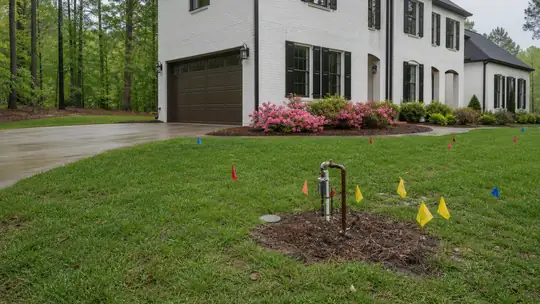
Utility flags mark buried lines before digging starts. at a painted-white-brick two-story home in Bowling Green, KY, in late afternoon light.

Step 1: Site Assessment

Before we give an estimate, we walk the property and look at grade, drainage, truck access, and what sits under the old surface. The dominant soil here is Baxter, which drains well, but it changes across short distances, so we test every site on its own. We handle the permit when the project needs one.

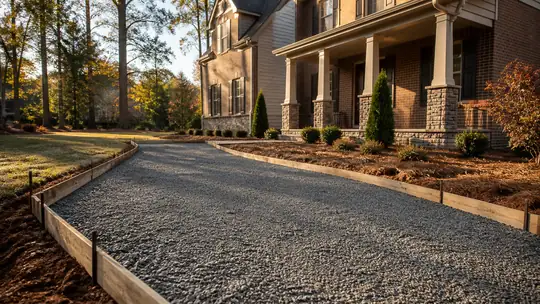
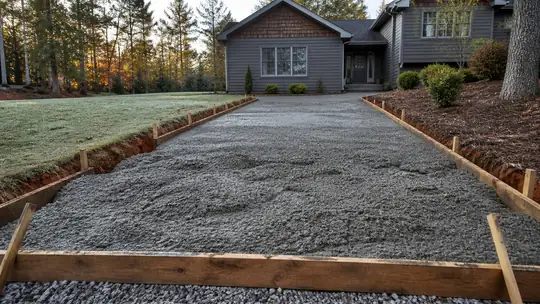
Crushed stone base is raked level inside driveway forms. at a brick-and-siding two-story home in Bowling Green, KY, in early morning light.

Step 2: Site Preparation

Digging out comes first: old concrete, sod and anything organic that would rot into a void. The ground here is hilly and shifts from block to block, so we set grade for runoff rather than assuming the lot is flat. Then a gravel base goes down, plate-tamped in lifts so nothing settles later.

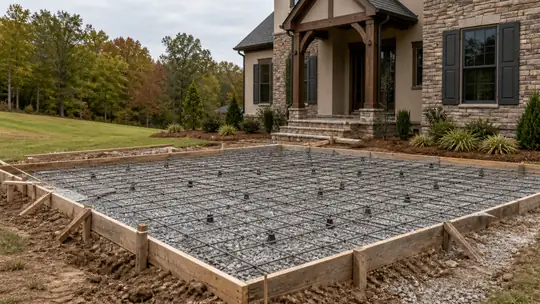
A worker ties rebar into a grid before a residential pour. at a stacked-stone and stucco home in Bowling Green, KY, in early morning light.

Step 3: Forming & Reinforcement

Forms are lumber or steel, staked and checked with a string line so the edges come out true. Inside them goes reinforcement sized to the job: welded wire mesh for most patios and walks, rebar on a grid for driveways that carry trucks. We set it on chairs, because steel lying on the gravel does nothing.

A ready-mix truck discharges concrete into a driveway form. at a grey split-level home in Bowling Green, KY, under low winter sun.

Step 4: Pouring

Ready-mix arrives from the plant with a mix chosen for the job, and we place it fast, working from the far end back toward the truck. Adding water at the chute makes concrete easier to spread and weaker once it sets, so we skip it. Vibrating or rodding the edges removes air pockets along the forms.

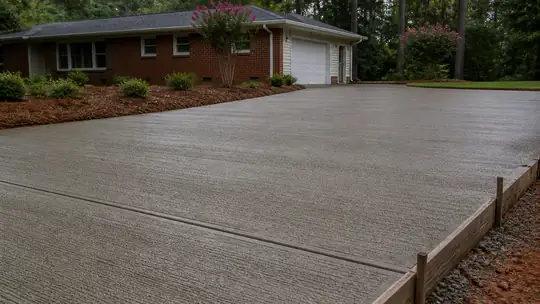
A broom drags across a driveway creating a slip-resistant texture. at a red-brick ranch home in Bowling Green, KY, under an overcast sky.

Step 5: Finishing

Screeding strikes the surface flat, then a bull float pushes the stone down and brings cream up. Timing is everything: finish too early and bleed water gets trapped, which leads to scaling. Once it firms, we edge the perimeter, groove control joints, and broom it for grip or stamp it for decorative work.

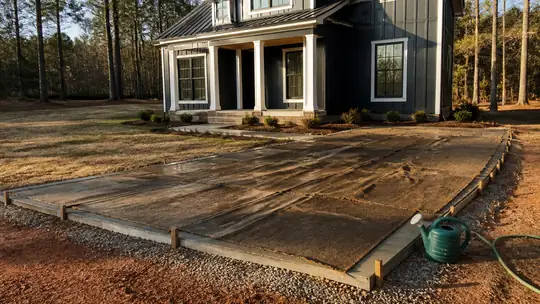
Damp burlap covers a small slab section during curing. at a charcoal farmhouse-modern home in Bowling Green, KY, after a rain shower.

Step 6: Curing

Curing is where most cracked slabs go wrong, because the surface dries faster than the core. We hold moisture in with a curing compound or wet burlap under plastic. Foot traffic comes back first. Cars wait longer, because a driveway has to gain real strength before it carries a loaded vehicle.

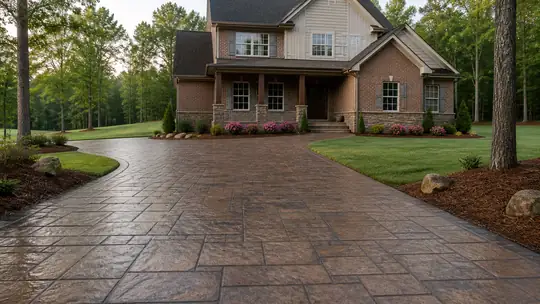
A finished stamped surface shows a glossy sealed sheen. at a brick-and-siding two-story home in Bowling Green, KY, under an overcast sky.

Step 7: Sealing

Sealer goes on once the slab has fully cured, never on fresh concrete. We use a penetrating sealer on broom finishes and an acrylic on stamped and colored work, which also deepens the color. It sheds water and keeps oil from soaking in. Reapplying every few years keeps the surface looking the way it did.

Top Decorative Concrete Styles for Bowling Green Homes

Stamped concrete is what most people ask about, and for good reason. We press a pattern into the slab while it is still workable, so a patio can read as slate, cobblestone or wide wood planks without the gaps that shift and collect weeds in laid stone. Exposed aggregate is the other finish we pour often. We wash the top layer away to show the stone underneath, which leaves a rough, grippy surface that suits driveways. For a quieter look, a plain broom finish with a stamped or colored border does a lot with very little.

Every decorative job starts the same way as a plain one: with the base. The ground around here is hilly, though it changes from one block to the next, and a sloped yard changes how a patio has to be graded and where the water goes. So we grade and test each site on its own before any forms go in. Color goes into the mix or onto the surface as it sets. Timing matters most on stamped work. The mats go down in a short window, and we bring enough hands to press the whole slab before it stiffens.

Most decorative concrete that disappoints was pressed too late, sealed with the wrong product, or poured without proper reinforcement under a pretty top. A pattern stamped into a slab that has started to set comes out shallow and patchy, and no sealer hides that. A glossy sealer on a sloped driveway can turn slick when it rains, so we match the finish to where people walk and park. The rebar or wire under stamped concrete matters as much as it does under a plain slab. The design lives on the surface. The strength is underneath it.

What Decides the Price of General Concrete Construction

Two slabs the same size can land far apart on a quote, and the reasons are almost always sitting on the property itself. Most of them you can walk out and check before anyone hands you a number.

What changes the priceWhich wayWhy
Old concrete or asphalt to tear outcosts moreBreaking it up, loading it and hauling it off is labor and disposal before the new work starts.
Slope across the pour areacosts moreWarren County is hilly, and a sloped site needs more grading, deeper forms on the low side, and sometimes a step.
Truck access to the formscosts less when clearIf the mixer can back up to the pour, it chutes straight in. A narrow gate, a fence or a soft lawn means pumping or wheelbarrows.
Slab thicknesscosts more when thickerA walkway and a pad that carries a truck or trailer are not the same slab. More depth means more concrete and more base.
Reinforcementcosts moreRebar or wire mesh, set on chairs so it sits mid-slab, adds material and setting time.
Where water goes nowcosts more if it poolsLow spots, downspouts emptying onto the work area, or runoff from uphill need regrading or a drain first.
Roots, stumps and buried linescosts moreRoots come out, and anything buried has to be located and worked around.
Sound base already in placecosts lessA compacted gravel base from an old slab may only need topping up. Baxter soil drains well across much of the county, but we test every site before relying on it.

When you compare bids, line them up on the same points: slab thickness, what reinforcement goes in and how it is supported, base depth and material, whether tear-out and haul-off are included, and who handles the permit. A lower number that leaves one of those out is a different job. If a bid does not say, ask.

Get a Free Estimate

Get a Free Estimate

Tap to call +1 270-208-9064