+1 270-208-9064
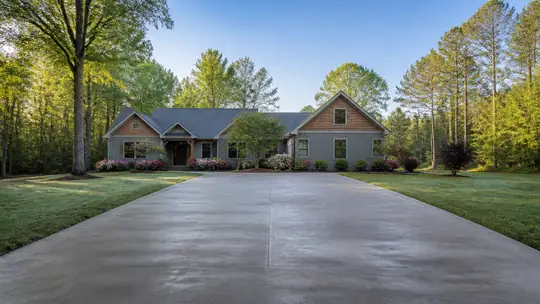
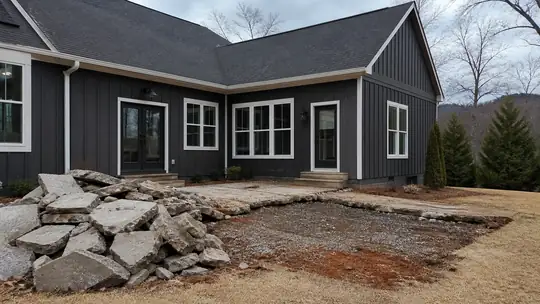
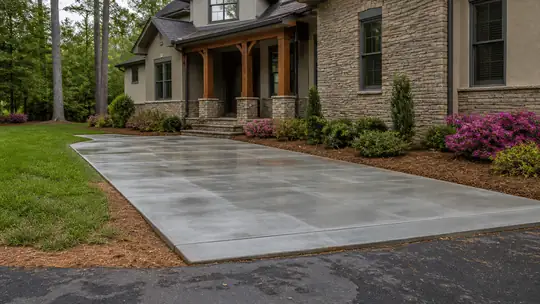
concrete slab installation completed by a local contractor at a buff-brick ranch home in Bowling Green, KY, after a rain shower.

Concrete Slab Installation in Scottsville, Kentucky

A concrete slab is the flat, reinforced base that everything else sits on: a garage floor, a shed pad, a patio, the footprint of a small addition. In Scottsville we pour residential and light commercial slabs sized to the load they will carry, not to a standard template. A slab under a parked truck needs different thickness and reinforcement than one under a grill and four chairs. So we ask what the surface is for before anything else. That answer sets the depth, the steel, the joint layout and the finish, whether that means a broom finish for grip or a stamped decorative surface on a patio.

The work starts below grade. We test the site first, because Baxter soil is the dominant type across Warren County but it varies from one property to the next, and a slab only performs as well as the ground under it. Then we excavate, compact a gravel base, set forms to grade, and place rebar or wire mesh on chairs so it sits inside the concrete rather than under it. Pour day is about timing. We place, screed, float and finish while the mix is still workable, then cut control joints and let the slab cure before it takes weight.

Most slab failures trace back to things nobody can see once the concrete is down. A soft spot in the subgrade that was never compacted. Reinforcement that slumped to the bottom and rests on the dirt. Control joints cut too late or spaced too far apart, so the slab picks its own cracking pattern. Water that drains toward the edge instead of away from it. Concrete cracks; that is its nature. The real job is deciding where it cracks and keeping the pieces level and tied together. When a slab settles or heaves, the cause is almost always in the preparation, not the pour.

Getting it right costs time and attention at exactly the stages people are tempted to rush. Base preparation, proper compaction, the correct thickness, steel placed where it belongs, a curing period that is not cut short: none of it shows when the job is finished, which is why it gets skipped. We would rather spend an extra day on the ground than leave a slab that sinks at one corner in a few years. Good materials matter, but they cannot make up for a poor base. If you are planning a slab in Scottsville, call us for a free estimate.
Call +1 270-208-9064

Get a Free Estimate

What We Do in Scottsville

Concrete Slab Installation Cost

What a slab costs depends on what sits under it and what goes in it. Excavation, compacted gravel base, thickness, rebar or wire mesh, forming and the finish all move the number, and so does how close a truck can get. We price each Scottsville slab after walking the site. Call for a free estimate.

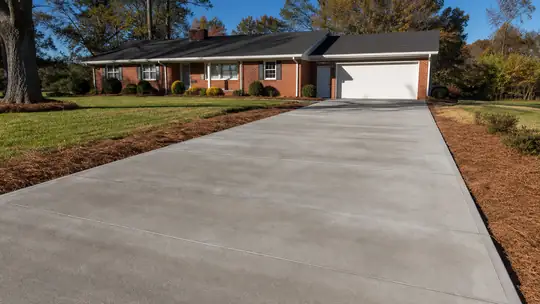
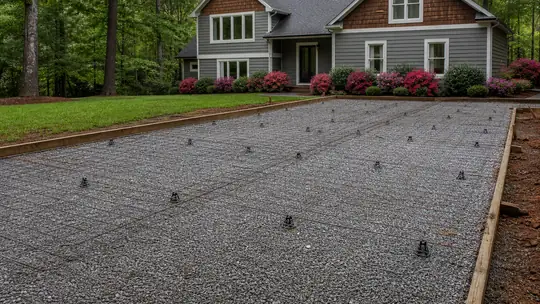
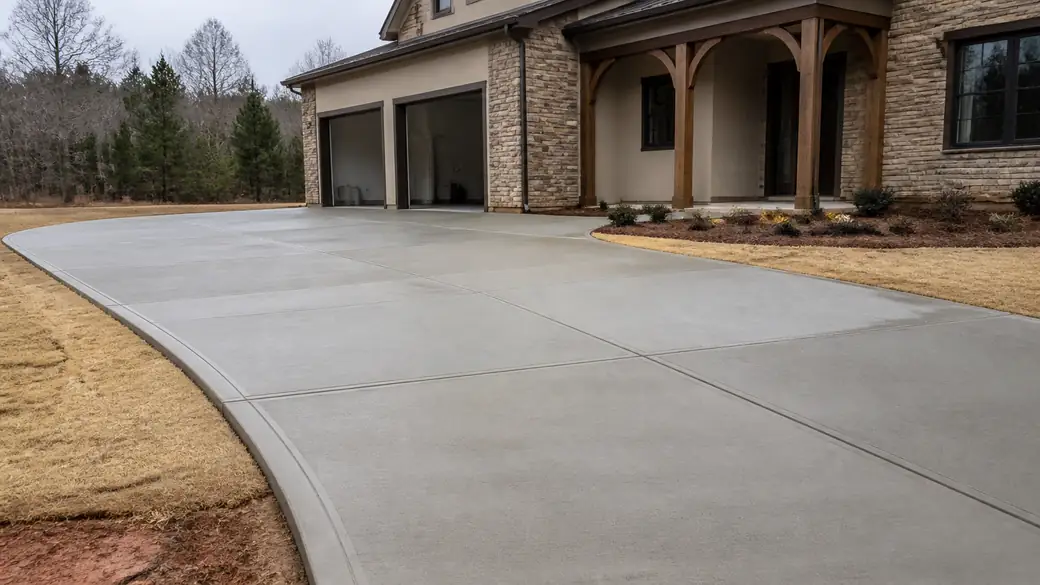
concrete driveway installation completed by a local contractor at a tan-brick colonial in Bowling Green, KY, in clear late-morning sun.

Concrete Driveway Installation

A driveway fails from the bottom up. We dig out organic soil, compact a gravel base, and set rebar on chairs so it sits mid-slab instead of on the dirt. Edges and the apron get extra thickness. Control joints are cut so cracks follow our lines, not their own. Stamped finishes are an option.

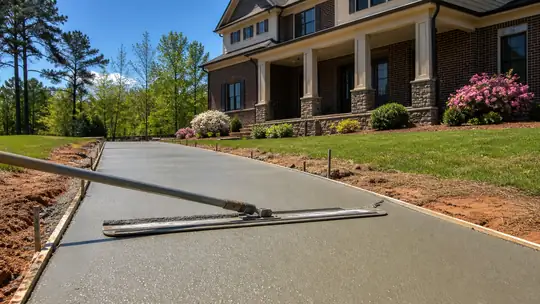
concrete flooring installation completed by a local contractor at a grey split-level home in Bowling Green, KY, at blue hour.

Concrete Flooring Installation

Garage, shop and basement floors need a vapor barrier under the slab, or moisture wicks up and lifts coatings and flooring laid over it. We place rebar or mesh, pour, and power trowel to a hard, flat surface. For a finished look we offer polished, stained or sealed concrete, plus epoxy coatings.

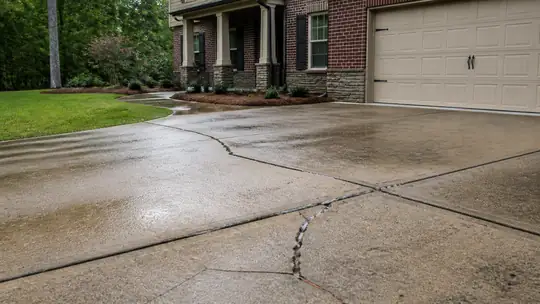
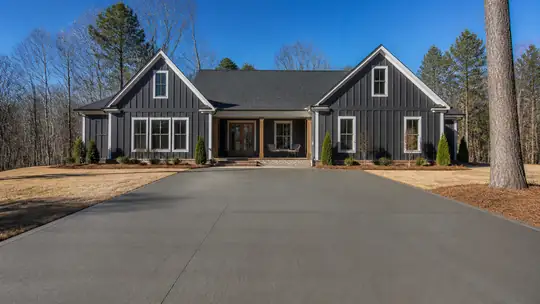
concrete slab repair completed by a local contractor at a painted-white-brick two-story home in Bowling Green, KY, in late afternoon light.

Concrete Slab Repair

Cracks, settling and spalling each have a different cause, and patching the surface without finding it just buys time. We check whether the base washed out, the slab was too thin, or joints were missing. Narrow cracks can be routed and sealed. Sunken or broken sections usually come out and get replaced.

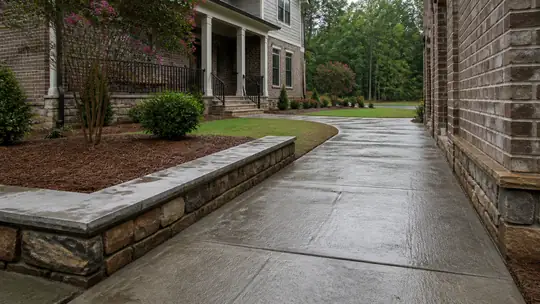
concrete sidewalk installation completed by a local contractor at a charcoal farmhouse-modern home in Bowling Green, KY, under an overcast sky.

Concrete Sidewalk Installation

A sidewalk that lifts at one joint becomes a trip hazard, so the base gets the most attention. We test the soil at every site, compact gravel, set a slight cross slope so water sheds, and cut joints at even spacing. Edges are tooled, and a broom finish keeps it from going slick when wet.

Why Choose Bowling Green Precision Concrete

A slab is only as good as what sits under it and what goes into it. We pour residential and commercial slabs in Scottsville for garages, shop floors, patios, driveways and the pad a new shed or addition will stand on. Each one gets the same attention to grade, thickness and reinforcement, whether it carries a pickup or a patio table. Some jobs call for a plain broom finish. Others want a stamped or decorative surface that has to look right for years. We do both, and we treat the base work under a decorative slab as seriously as the finish on top.

Before any forms go in, we test the site. Soil changes from one property to the next, sometimes across a single lot, so we assume nothing about the ground until we have checked it. From there we set the grade, compact the base, and set the rebar or wire mesh on chairs so it ends up inside the concrete instead of under it. We pour when conditions allow. Control joints get cut on schedule, and the slab cures properly before anyone drives or builds on it. None of that is fast. It is the part that decides how the slab behaves.

Most slab failures trace back to the same few mistakes. A base that was never compacted settles, and the slab cracks over the low spot. Reinforcement laid flat on the dirt does nothing at all. Control joints cut too shallow, or spaced too far apart, let the concrete crack wherever it likes. Water left to pool against a foundation or run under an edge finds the weak point eventually. None of this shows on the day of the pour. It shows a year or two later, when the only real fix is breaking out the concrete and starting over.

Getting it right is mostly a matter of not skipping steps. Proper base preparation, the right thickness for the load, reinforcement where it belongs and joints placed with a plan all add time to a job. We build that time in rather than trimming it to come in lower on a bid, because a slab that has to be torn out costs far more than one poured correctly the first time. Every quote is written for the specific property and its conditions, so the number reflects the real work. If you have a slab, patio or driveway in mind in Scottsville, call for a free estimate.

How a Concrete Job Runs in Scottsville

A worker examines an old driveway before replacement. at a brick-and-siding two-story home in Bowling Green, KY, under bright midday cloud.

Step 1: Site Assessment

We walk the property with a tape, a level and a probe rod before anything is drawn up. Every site is tested individually before work starts, because we never assume what sits under the grass. We check drainage, slope, tree roots and buried lines, then settle slab thickness and reinforcement for the load it carries.

An old patio slab is broken up and hauled away. at a charcoal farmhouse-modern home in Bowling Green, KY, under bright midday cloud.

Step 2: Site Preparation

Excavation comes next. We strip topsoil and organic material down to firm ground, then lay four inches of compacted crushed stone as the base. A plate compactor goes over it in lifts, not all at once. A slab that cracks in its first year usually failed here: soft fill, or a base nobody compacted.

Wire mesh is unrolled across a driveway base before pouring. at a grey split-level home in Bowling Green, KY, under bright midday cloud.

Step 3: Forming & Reinforcement

We stake lumber forms to line and set them with a slight fall so water drains off the surface. Inside them we place rebar or welded wire mesh on plastic chairs, so the steel sits in the middle of the slab instead of on the ground. Steel lying in the dirt does nothing.

A bull float smooths a residential walkway surface after screeding. at a brick-and-siding two-story home in Bowling Green, KY, after a rain shower.

Step 4: Pouring

Concrete arrives by ready-mix truck, and we place it as close to its final spot as the chute allows. Adding water at the site makes it easier to spread and weaker once it sets, so we don't. The crew screeds it level off the forms and works steadily, because concrete will not wait.

A hand trowel smooths a small patio surface to a hard finish. at a charcoal farmhouse-modern home in Bowling Green, KY, after a rain shower.

Step 5: Finishing

Finishing is about timing. We bull float the surface, let the bleed water go, then trowel and broom it for grip. Stamped and decorative patios get their pattern while the slab is still workable. Control joints go in a quarter of the slab's depth, so cracks run where we put them.

A hand sprayer applies curing compound to a finished patio. at a stacked-stone and stucco home in Bowling Green, KY, under low winter sun.

Step 6: Curing

Strength comes slowly. Concrete gains it by holding moisture, so we keep a new slab damp or cover it with a curing compound through the first week. A slab that dries too fast on a hot or windy day ends up with a dusty, weak surface. Feet go on it before tires do.

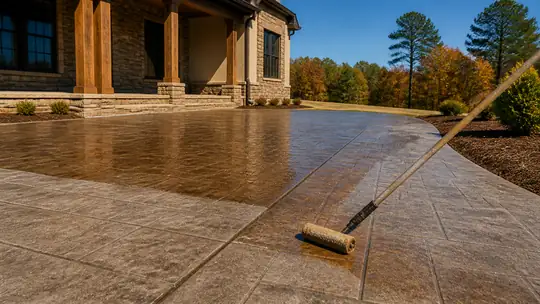
A roller applies sealer to a stamped patio surface. at a stacked-stone and stucco home in Bowling Green, KY, at blue hour.

Step 7: Sealing

Once the slab has cured, we roll on a penetrating or acrylic sealer. It keeps water, oil and grease from soaking into the surface, and on stamped work it deepens the color. Sealer wears, so it needs reapplying every few years. Skip it and oil stains set in for good on a driveway.

Frequently Asked Questions About Concrete in Scottsville

How do you minimize dust, noise, and disruption on occupied Scottsville properties during demolition ?

We cut old concrete wet, which keeps most of the dust on the ground instead of drifting through the house. Doors and windows near the work get sheeted in plastic, and the equipment follows one marked path so nobody has to guess where it is going. Breaking and hauling happen during normal daytime hours. If someone in the home works nights or has a baby who naps, tell us before the job starts so the loud part can be planned around it.

Are you licensed and insured?

That is something to settle with paper, not with a sentence on a website. Before you sign with any concrete contractor, us included, ask for current documents and confirm them with the office that issued them. It takes a few minutes. A contractor who is set up properly hands those over without fuss, and one who hesitates has already told you what you needed to know.

Are you fully licensed, insured, and bonded for commercial work in Southern Scottsville?

Commercial work raises the stakes, so the same advice carries more weight here. Owners and property managers should ask for license, insurance and bonding paperwork together, read the coverage on each, and verify every document directly with its source before a contract is signed. Bonding requirements can differ from one project to the next. Ask what your particular job calls for, and check rather than take anyone's word for it, ours included.

What types of commercial projects does Bowling Green Precision Concrete handle?

Slabs for shops, warehouses and equipment buildings are the core of it, along with the sidewalks, curbs, aprons and parking pads that surround them. We also pour footings and structural foundations to an engineer's drawings, with the reinforcement those plans call for. Decorative and stamped surfaces fit storefront entries and outdoor seating areas where appearance matters as much as strength. If a Scottsville property needs concrete placed, reinforced and finished, it is worth a call.

How does Bowling Green Precision Concrete protect our property and keep the job site clean?

Before the first truck backs in, we lay plywood or mats over any lawn it has to cross and mark sprinkler heads, cleanouts and anything else buried near the pour. Washout water stays in a contained area, not in your yard or the storm drain. Tools are put away at the end of each day. Debris goes into a bin or off site, so the property stays usable while the work is underway.

How deep do commercial foundations need to be in Scottsville?

Depth comes from the building, not from a rule of thumb. The loads it carries, the size of the footprint and the ground underneath all set the answer, which is why nobody should quote one figure for a whole town. Baxter soil, which is well drained, is the dominant type in Warren County, but soil varies from site to site. Every site is tested individually before work starts, and footings are then sized to the engineered plans.

Get a Free Estimate

Get a Free Estimate

Tap to call +1 270-208-9064