+1 270-208-9064
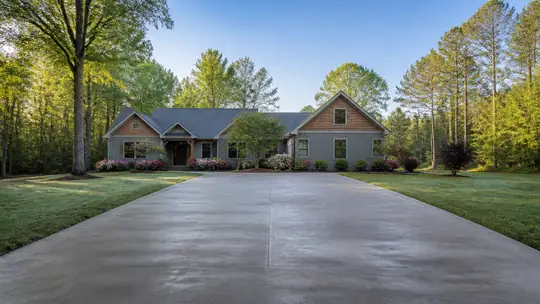
concrete slab installation completed by a local contractor at a buff-brick ranch home in Bowling Green, KY, after a rain shower.

Concrete Slab Installation in Franklin, Kentucky

A concrete slab is the flat, load-bearing surface everything else sits on: a garage floor, a shed pad, the base under a patio, the floor of a shop or a small commercial building. We pour slabs across Franklin for residential and commercial property owners, and the job follows the same logic at every size. Get the ground right. Set the forms square and level, put the reinforcement where it will actually do its work, and finish the surface for what it has to carry. A slab that looks good on the first day but was built on a guess is not finished. It is a repair on a delay.

Most of the work happens before the truck shows up. Soil changes from one piece of ground to the next, so every site is tested individually before work starts, and that result decides how much base goes in and how deep we dig. We grade, compact the base in lifts, and set forms to the finished height. Rebar or wire goes up on chairs so it sits inside the slab instead of lying on the dirt underneath it. Control joints are laid out before the pour, not cut wherever they happen to land. Then we place, screed, float, finish and cure.

Slabs fail for reasons nobody can see once the concrete is down. A soft spot left in the subgrade. Reinforcement that sank to the bottom during the pour. Joints spaced too far apart, or a slab driven on before it had time to cure. What you get is cracking that wanders across the surface, corners that settle, and water that sits where it should run off. Doing it right takes more time on the prep and more patience on the cure, and we plan for both from the start. If you have a new slab to pour or an old one to replace, call us for a free estimate.

Call +1 270-208-9064

Get a Free Estimate

What We Do in Franklin

Concrete Slab Installation Cost

A slab's cost comes down to size, thickness and what sits under it. A shed pad on firm ground is a lighter job than a garage slab with rebar, a thickened edge and a rebuilt stone base. We price the slab in front of us, not one from a chart. Call for a free estimate.

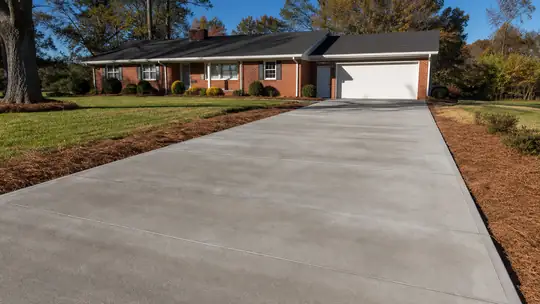
concrete driveway installation completed by a local contractor at a tan-brick colonial in Bowling Green, KY, in clear late-morning sun.

Concrete Driveway Installation

We thicken a driveway where trucks and trailers park, not only where cars roll in. Rebar sits on chairs at mid-depth, because steel lying in the dirt does nothing. We saw-cut control joints within hours of the pour so the slab cracks where we choose. Broom finish is standard; stamped is available.

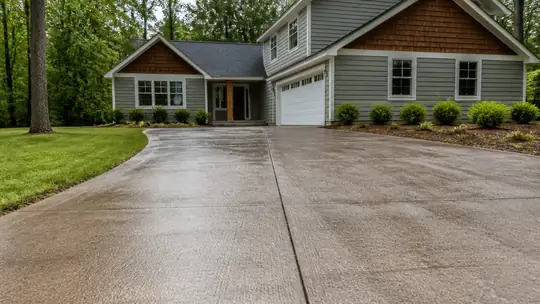
concrete flooring installation completed by a local contractor at a grey split-level home in Bowling Green, KY, at blue hour.

Concrete Flooring Installation

Interior floors for shops, garages and basements start with a heavy vapor barrier over compacted stone, so ground moisture stays out of whatever goes on top later. We finish with a steel trowel for a hard, tight surface that sweeps clean. Sealing, staining and decorative finishes can follow once the slab has cured.

concrete slab repair completed by a local contractor at a painted-white-brick two-story home in Bowling Green, KY, in late afternoon light.

Concrete Slab Repair

Before we fix a cracked or sunken slab, we find out why it moved. Hairline shrinkage cracks can be routed and sealed. A slab that settled because the base washed out needs that section cut out, the base rebuilt and new concrete doweled into the old. Patching over a void only hides it.

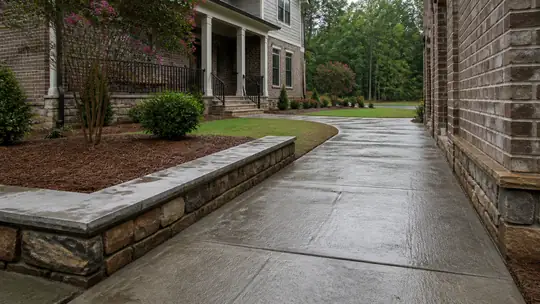
concrete sidewalk installation completed by a local contractor at a charcoal farmhouse-modern home in Bowling Green, KY, under an overcast sky.

Concrete Sidewalk Installation

Sidewalks and walkways get a slight cross-slope so water runs off instead of standing on the surface. We tool joints at close, even spacing and set expansion joints where the walk meets a driveway, step or foundation. Underneath goes compacted stone, not loose fill, so panels stay level with each other.

Why Choose Bowling Green Precision Concrete

We pour slabs, driveways, patios and decorative surfaces for residential and commercial property owners, and the reason to hire us comes down to the part of the job you never see. A slab is only as good as the ground and the reinforcement under it. We would rather spend an extra hour on the base than an extra minute explaining a crack later. That habit is most of what we offer. It does not show up in a photo of the finished work. It shows up years on, in a surface that still sits flat, drains where it should, and has not pulled away from the garage.

Warren County's dominant soil is Baxter, which is well drained, but it varies across the county, so we never assume. Every site is tested individually before work starts. The base, the forms and the reinforcement are then set to what that test finds, not to what worked on the last job. If the conditions on your property call for a change to the plan, you hear the reason from us before anything is poured. No decision about your concrete gets made quietly and discovered after it has set. That is how we would want our own driveway handled, and it is how we handle yours.

Most concrete failures are decided before the truck arrives. Thin reinforcement, a rushed base, control joints cut late or spaced too far apart: those shortcuts sit behind a lot of the cracked driveways and sunken patios people live with. None of them save much. They just move the cost from the day of the pour to the years after it. Doing the work right mostly costs attention, and we would rather give it up front. Whether it is a garage slab in Franklin or a stamped patio out back, the standard is the same. Call for a free estimate.

How a Concrete Job Runs in Franklin

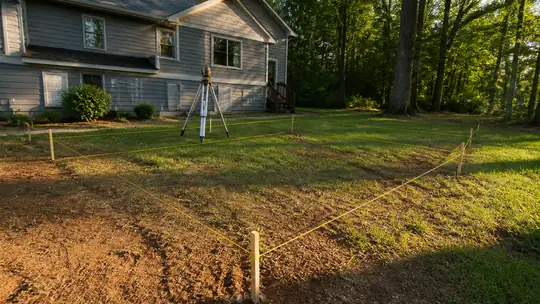
A contractor checks slope and drainage before work begins. at a grey split-level home in Bowling Green, KY, in clear late-morning sun.

Step 1: Site Assessment

We walk the property, mark where water runs, and dig to see what sits under the topsoil. Baxter soil, Warren County's dominant type, is well drained, but it varies across the county, so every site is tested individually before work starts. That test decides the base, the thickness and the reinforcement.

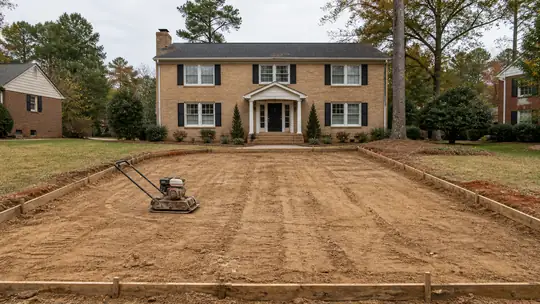
A plate compactor tamps down soil in a small excavated area. at a tan-brick colonial in Bowling Green, KY, at blue hour.

Step 2: Site Preparation

Grass, roots and soft fill come out until we reach firm ground. We set grade so water sheds away from the house, then spread crushed stone and compact it in lifts with a plate compactor. Most slab cracks start here, with a stone base that settled because nobody packed it properly.

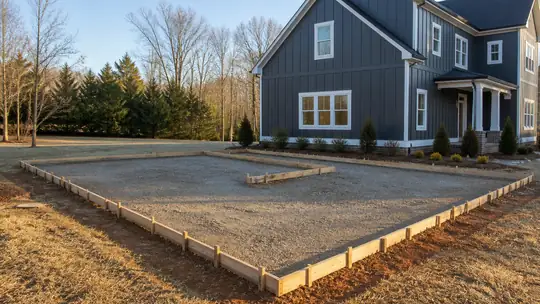
Wooden forms outline a patio slab before the pour. at a charcoal farmhouse-modern home in Bowling Green, KY, in late afternoon light.

Step 3: Forming & Reinforcement

Forms go up in straight lumber, staked tight and checked with a string line so the surface drains as planned. Inside, we lay rebar or welded wire on plastic chairs. Steel lying flat in the gravel does nothing; it has to sit mid-slab to hold cracks tight. Driveways get heavier steel than patios.

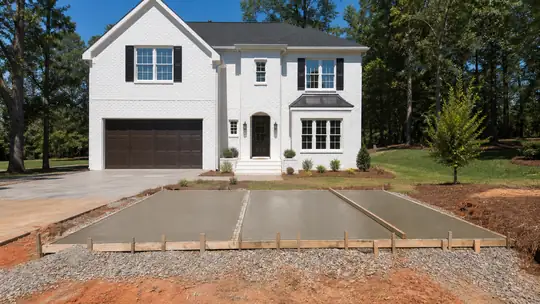
A screed board levels fresh concrete on a small patio. at a painted-white-brick two-story home in Bowling Green, KY, at blue hour.

Step 4: Pouring

The truck backs in as close as the property allows, and we chute or wheelbarrow from there. Everything goes down in one continuous pour, raked level and screeded flat against the forms. Extra water at the truck makes concrete easier to place and weaker once it sets, so we skip it.

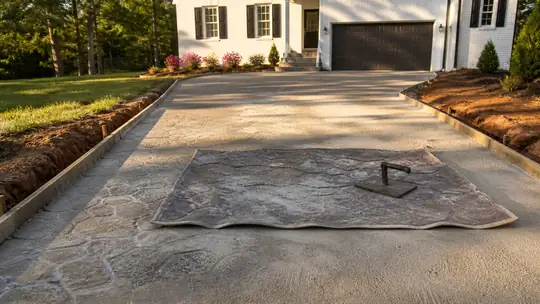
Stamping mats are pressed into a patio surface to imprint a pattern. at a painted-white-brick two-story home in Bowling Green, KY, after a rain shower.

Step 5: Finishing

We bull float right behind the screed, then wait for the bleed water to leave before edging and cutting control joints, so cracks fall in a straight line. Driveways and walks get a broom finish for grip. Stamped patterns go in while the surface is still soft enough to take them.

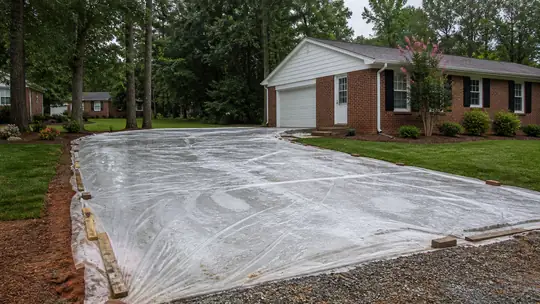
Plastic sheeting covers a curing driveway slab. at a red-brick ranch home in Bowling Green, KY, in late afternoon light.

Step 6: Curing

Concrete gains strength by holding on to its water, not by drying out. Right after finishing we spray a curing compound or cover the slab with wet burlap or plastic. Foot traffic waits a few days; cars wait longer. Rushing this step is how a strong mix ends up weak.

A sprayer applies sealer across a driveway. at a grey split-level home in Bowling Green, KY, in early morning light.

Step 7: Sealing

Sealer goes on after the slab has cured, not before, so trapped moisture doesn't cloud it. We roll or spray a penetrating sealer on broom-finished driveways and a film-forming sealer on stamped and decorative surfaces to hold the color. It keeps out oil, water and road grime. Resealing every few years keeps it working.

Concrete Systems and Materials for Franklin

A slab is only as good as what sits under it and what runs through it. For residential and commercial work in Franklin, we build each one as a system: a compacted base, reinforcement sized for the load, a concrete mix chosen for the job, and a finished surface that suits how the property gets used. Driveways carry vehicles. Patios carry furniture and foot traffic. Shop floors carry both, plus whatever rolls across them. Each gets its own combination of materials, not one recipe poured everywhere.

Testing the ground comes before anything else. Soil varies from one lot to the next, so every site is tested individually before work starts, and what we find sets the depth of the base and how firmly we compact it. From there we set forms, place rebar or wire mesh on chairs so it sits inside the slab rather than on the dirt, and lay out control joints before the truck arrives. Stamped and decorative finishes get their pattern and color settled at this stage too, while there is still time to change them.

Most cracked and sunken slabs fail for ordinary reasons. The base was thin or loose. Reinforcement was laid flat on the ground, where it does nothing at all. Water was added at the truck to make the concrete easier to spread, which leaves a weak, dusty surface. Joints were cut too late or too shallow, so the slab picked its own place to crack. None of this shows on the day of the pour. It shows a year or two later, when the only real fix is tearing out and starting over.

Doing it properly costs time and attention more than anything exotic. It means compacting the base in lifts instead of all at once, holding the mix to spec even when a wetter load would finish faster, and keeping the slab damp while it cures rather than walking away once it looks hard. Sealing a stamped or decorative surface takes another visit. None of it is glamorous. All of it decides whether a driveway or patio in Franklin is still flat and whole long after the forms come off.
What Decides the Price of Concrete in Franklin

Most of what moves the price of a slab sits under it or around it, not in the concrete itself. Before we quote, we walk the property and look at what has to come out, how a truck gets in, and where the water goes. Soil varies from one lot to the next, so every site is tested before work starts.

What changes the priceWhich wayWhy
Old concrete, asphalt or pavers in the footprintCosts moreBreaking it out and hauling it away is labor and truck trips before any new work begins.
Stumps, roots or buried debrisCosts moreThey come out, and the hole gets backfilled and compacted, or the slab settles over them later.
A ready-mix truck can back up to the formsCosts lessWe chute the concrete straight in. Without that access, it takes a pump or wheelbarrows and more crew hours.
Slope across the slab areaCosts moreThe low side needs deeper forms, more fill and more concrete to bring the surface level.
Water that pools where the slab will goCosts moreWe add base stone and regrade so water drains away instead of sitting under the slab.
Vehicles or heavy equipment on the finished slabCosts moreA garage or shop floor calls for more thickness and heavier reinforcement than a patio.
Rebar grid instead of wire meshCosts moreRebar takes more material and more time to tie and set on chairs at the right height.
Water, gas or electric lines under the footprintCosts moreLines get located and sleeved, and we form around them so they stay reachable.

Comparing bids? Line them up on the same points: slab thickness, depth of the stone base and how it gets compacted, the type and spacing of reinforcement, and whether tear-out and haul-off are included. Two numbers that look far apart often describe two different slabs. Ask each contractor to put those details in writing, then compare like with like.

Get a Free Estimate

Get a Free Estimate

Tap to call +1 270-208-9064